The freefly chapter
Head-down, at 240 km/h
Your strongest BrainFlow result came from head-down tilt. In my freefly chapter, I fly head-down at 240 km/h or more, hundreds of times. Same posture, far harder.
Starting January 1, 2027, I'm doing 1,500 skydives in a single year, four or five every day. Hundreds of them head-down, the posture your own BrainFlow study tracked best. I want Temple on for every one, and I'll share everything it records.
Every one of these happens to the same body, in the same year.
About twenty minutes from takeoff to landing, with the same phases in the same order, 1,500 times. That makes each reading easy to line up with the last one.
Your strongest BrainFlow result came from head-down tilt. In my freefly chapter, I fly head-down at 240 km/h or more, hundreds of times. Same posture, far harder.
Your studies used tilt tables, cycling and heat. This is 14,000 ft in fifteen minutes, then 240 km/h and back to the ground in five. Same body, real conditions.
Where does Entropy go at the open door, and does that spike shrink from jump 1 to jump 1,500? The question behind this whole project, as a number.
I already wear a wrist wearable every day. With Temple on too, every jump becomes a side-by-side: temple against wrist, 1,500 times, with notes on each one.
Do my readings on the ground before a load say anything about how the jump goes? Four or five chances a day to find out.
Every jump, every dollar and every reading goes public, with no health claims. I'll show what Temple recorded and let it speak for itself.
This isn't a billboard. A year like this needs an instrument, and Temple is the one I'd pick.
Relaxed flyers learn faster, and tense ones fight the air. You learned to meditate by watching Entropy fall. I want to learn to settle on the ride up the same way.
Four or five jumps a day wears you down before you feel it. Seeing the trend helps me and my coaches pick the days to push and the days to pack it in.
Feeling less scared is easy to imagine. Watching the spike at the door actually shrink, month after month, is something I can see and show.
Whatever you decide, every reading goes public: raw data to your team, notes on every jump, Temple named, no health claims. Nothing scripted, nothing staged. Just what Temple records, jump after jump.
A unit for the year, so the data starts at jump one. That's all it takes to get 1,500 sessions on record.
If your science team thinks this data is worth studying, I'd love to be part of it. Run it like your Art of Living one: you design it, I do the jumps, results published openly.
Every jump is a data point, and every dollar of the year is public in the open book. Back any part and you're funding data, not posts.
Before it goes on jump one, I'll test Temple on fun jumps: how it fits under my helmet and goggles, whether the signal holds in freefall, and sign-off from my drop zone's safety advisor. I'll share those results whether or not we go further.
From jump one: Temple on from the climb to landing, notes logged for every jump, raw data shared with your team, and Temple credited everywhere I post.
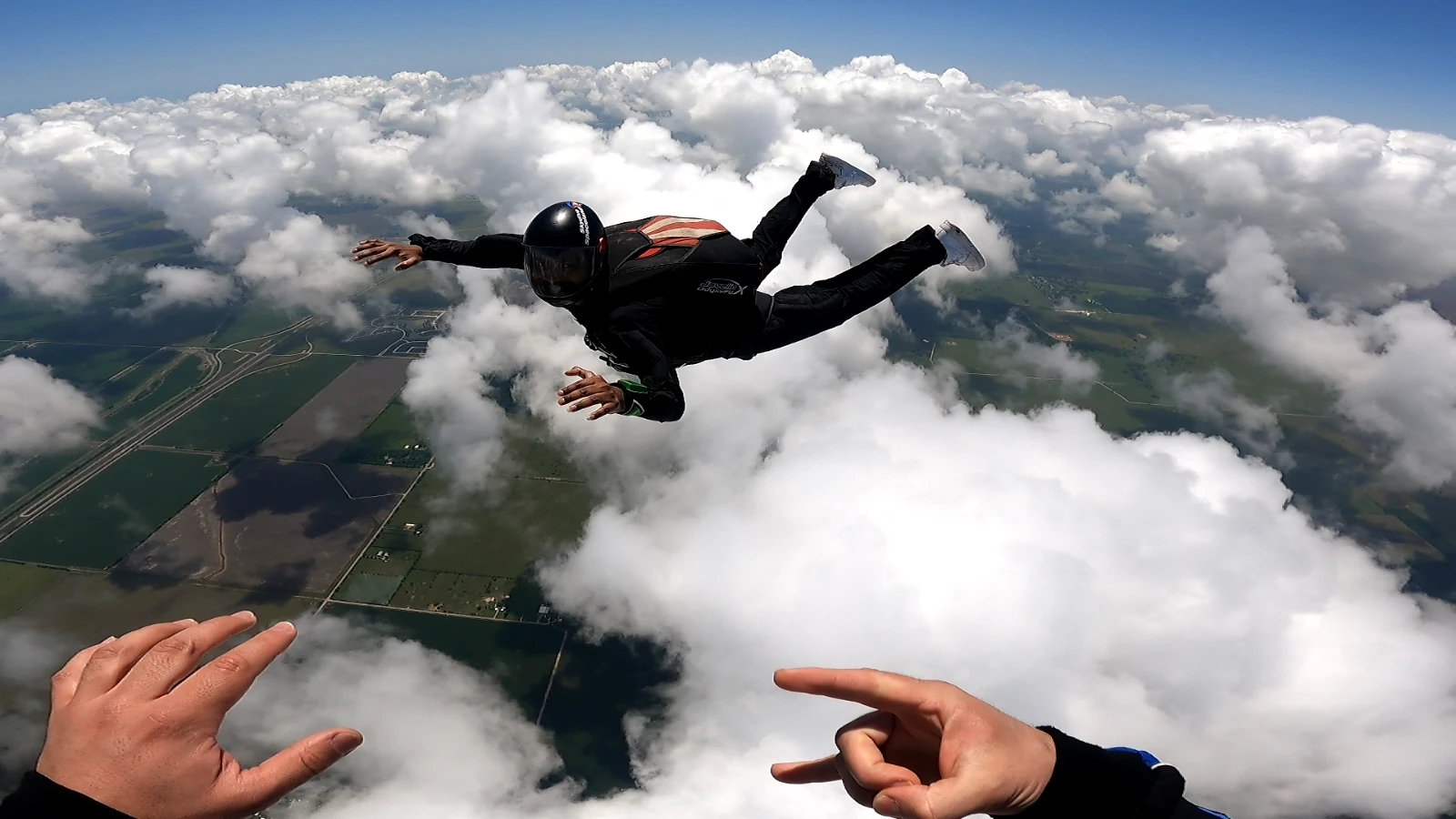
I'm Bheeshma, 26, from India. 82 jumps so far (121 by the end of December), USPA A and B licenses, at Skydive Spaceland Houston. I'm going all in for a year to become a seriously good skydiver, and doing it in public.
Jump 1/1500 is January 1. I'd love Temple on it.